For international trading companies, finding overseas customers is only the first step. Receiving payments securely, reliably, and at a reasonable cost is essential to completing a sale.
Companies new to international trade may find it difficult to choose between bank wire transfers, card payments, third-party payment providers, and multi-currency accounts.
No single payment method suits every international trading company.
Choose based on customer locations, order values, transaction frequency, product types, payment processing costs, and cash flow requirements.
This guide explains common cross-border payment methods for international trading companies in 2026 and how to assess them against your business needs.
1. Five common ways to receive cross-border payments
Common options include:
- Bank wire transfer (T/T)
- Credit and debit card payments
- Third-party cross-border payment providers
- Multi-currency business accounts
- Local payment methods
Each method suits different business needs.
2. Bank wire transfers (T/T): a common choice for large B2B orders
Bank wire transfers are often referred to as:
T/T (Telegraphic Transfer)
This is a common payment method in traditional international trade.
The general process is:
Overseas customers → Overseas banks → SWIFT/cross-border banking system → Corporate bank accounts
Bank wire transfers remain a common choice for high-value B2B orders.
Which businesses does it suit?
For example:
- Mechanical equipment
- Industrial equipment
- Building materials
- Raw materials
- Wholesale purchasing
- Bulk trade
- OEM orders
Suppose an overseas customer orders goods worth:
USD 50,000
In this case, using a bank wire is usually more appropriate than a credit card.
Advantages
① Suitable for large transactions
The larger the order amount, the greater the advantages of bank wire transfer.
② Direct payment to the company account
The payment route is relatively clear and suitable for ongoing business operations.
③ Suitable for traditional B2B trade
Many overseas buyers are accustomed to paying through banks.
Drawbacks
The main considerations are:
Transfer speed, processing fees, and payment procedures.
Sending banks, intermediary banks, and receiving banks may each charge fees.
New customers may also hesitate to pay if the international wire transfer process is complicated.
3. Card payments: useful for smaller, frequent, and online orders
For smaller purchases, customers may spend amounts such as:
$100, $500, $1,000, $3,000
For these orders, particularly those placed online, a card payment may be more convenient.
Customers may pay using cards from networks such as:
- Visa
- Mastercard
- American Express
- Discover
These cards allow customers to complete payments online.
Which businesses does it suit?
For example:
- Independent online stores serving overseas customers
- Cross-border e-commerce
- SaaS
- Digital services
- Software services
- Small wholesale orders
- Online subscriptions
- Sample orders
The main advantage of card payments is:
Convenient checkout for customers.
Customers can pay online without entering detailed international transfer instructions in a banking app.
4. Understand chargebacks when accepting card payments
Although card payments are convenient, businesses need to understand:
Chargebacks
A chargeback involves a cardholder disputing a payment through the issuing bank, for reasons such as goods not received, duplicate charges, fraud, or other transaction issues.
A persistently high chargeback rate may lead to:
- Additional risk controls from the payment provider
- Reviews of funds held by the provider
- Transaction restrictions
- Reserve requirements
- Closure of the payment account
When choosing a card payment provider, ask more than:
"How much is the handling fee?"
Also ask:
"How do you manage payment risk?"
5. Third-party payment providers: an option for small and medium-sized trading companies
Third-party cross-border payment providers can offer a convenient option for small and medium-sized trading companies.
They usually provide:
Payment collection + currency conversion + settlement + withdrawals
These services help businesses receive and manage overseas payments.
Choose a provider that matches your business needs.
Advantages
① Simpler processes
Some third-party providers offer more of their account opening and payment collection processes online than traditional banks do.
② Multi-currency support
Some platforms can support:
- USD
- EUR
- GBP
- HKD
- JPY
Other currencies may also be available.
③ Suitable for small and medium-sized enterprises
These services may be easier to adopt for smaller companies without complex financial systems.
What to check
When choosing a third-party payment platform, be sure to confirm:
Licensing, safeguards for customer funds, supported payment countries, settlement times, fees, and business restrictions.
Don’t choose a payment platform simply because of “low handling fees.”
6. Multi-currency business accounts: managing payments across markets
If your customers are from:
USA + UK + Europe + Japan
Converting every payment from a different currency may add costs.
Consider using:
A multi-currency business account.
For example, a company may hold accounts in:
USD account
EUR account
GBP account
JPY account
Overseas customers can pay in local currencies, while the company can convert and settle funds according to its cash flow needs.
Advantages
Reduce frequent currency exchanges.
For example:
UK customers pay in GBP.
Customers in the eurozone pay in EUR.
US customers pay in USD.
Businesses can decide when to exchange based on exchange rates and funding arrangements.
This can be useful for companies with ongoing cross-border operations.
7. Local payment methods: supporting customers in target markets
In addition to bank cards and bank transfers, different countries have their own local payment habits.
For example, some markets may be more accustomed to:
- Local bank transfer
- Local e-wallet
- Local bank card
- Local payment network
When entering a specific market, find out:
Which payment methods do local customers prefer?
For example, card payments and ACH transfers may be relevant for the US market.
For European markets, assess local card payments, bank transfers, and other methods based on the country and customer type.
Do not assume one payment method suits every country.
8. Four factors to consider when choosing cross-border payment methods
When many companies choose a payment collection platform, they only ask one question:
"How much is the handling fee?"
In fact, this is not enough.
Focus on the following four factors.
1. Payment processing costs
Calculate the total cost:
Handling fee + exchange rate cost + withdrawal fee + other possible fees
For example:
Platform A charges a processing fee of 1%.
Platform B charges a processing fee of 0.6%.
Platform B appears cheaper based on the processing fee alone.
However, higher currency conversion costs at Platform B could make its total cost higher.
So don’t just compare one rate.
2. Payment and settlement speed
For companies with tight cash flow:
The time it takes to receive funds matters.
Confirm:
- How long does it take for the payment to arrive?
- How long is the settlement cycle?
- Will it be processed on weekends?
- Do holidays delay processing?
- Are payments subject to review?
- How long does it take to withdraw money?
3. Which countries and currencies are supported?
Confirm in advance:
Where are the customers?
And:
What currency does the customer use?
For example:
United States → USD
United Kingdom → GBP
Eurozone → EUR
Japan → JPY
Multi-currency support matters when your customers are spread across several markets.
4. Risk control and compliance
Risk controls and compliance are often overlooked when receiving cross-border payments.
Businesses receiving cross-border payments need to consider:
- KYC
- KYB
- AML
- Transaction monitoring
- Source of funds
- Customer identity
- Business authenticity
- Transaction records
Businesses handling large payment amounts should prepare documents such as:
Contracts + invoices + orders + shipping records + customer information
These documents help substantiate the underlying business activity.
9. How can businesses of different sizes combine payment methods?
① Businesses new to international trade
Consider:
Bank account + third-party cross-border collection
Start by enabling customers to pay reliably, then develop your payment collection setup as the business grows.
② Small and medium-sized foreign trade enterprises
Consider:
Bank wire transfer + multi-currency account + online payment
Choose different methods according to the order amount.
Consider T/T for large orders.
Consider online payments for smaller orders.
③ Independent online stores serving overseas customers
It is recommended to focus on:
Bank card payment + local payment + multi-currency settlement
Customers shopping on an independent online store usually value:
Payment convenience.
Customers may abandon an order if a complicated bank wire transfer is the only payment option.
④ Large foreign trade enterprises
Larger businesses may benefit from:
A payment system with several channels.
For example:
Bank wire transfers
+
Multi-currency accounts
+
Card payment processing
+
Local payment methods
+
Business finance systems
This reduces reliance on a single payment collection channel.
10. Look beyond low processing fees
This is a very important point when choosing a cross-border payment method.
Many companies begin by asking:
"How much is your handling fee?"
Of course, handling fees are important.
For ongoing international trade operations:
Reliability matters more than low fees alone
A provider may charge low fees but also have problems such as:
- Frequent payment reviews
- Slow receipt of funds
- Frequent payment failures
- Lack of support for target countries
- Unreliable settlement
These problems can disrupt operations despite the low fees.
For example, suppose a company receives monthly payments totaling:
1 million US dollars
A difference of 0.3% in processing fees amounts to:
$3,000.
However, payment problems affecting a US$100,000 order could cause losses that exceed the US$3,000 saving.
Therefore, when a company chooses a payment method, it should calculate:
Total cost = processing fees + currency conversion costs + cost of tied-up funds + risk management costs + costs of disrupted business
Compare the full cost rather than the advertised fee alone.
11. Build a payment collection system with several channels
Avoid relying entirely on:
A single payment collection provider.
Instead:
Channel 1: Bank accounts
Used for:
Large B2B orders, long-term customers.
↓
Channel 2: Multi-currency accounts
Used for:
Customer payment collection and fund management in different countries.
↓
Channel 3: Online payments
Used for:
Independent online stores, small orders, and convenient checkout.
↓
Channel 4: Local payment methods
Used for:
Priority country markets.
This allows different payment methods to be selected according to different customers.
12. What should a cross-border payment collection system achieve?
A suitable cross-border payment method offers more than:
"The lowest handling fee".
Instead:
Convenient payment for customers
↓
Reliable payment acceptance
↓
Fund security
↓
Timely receipt of funds
↓
Settlement costs are reasonable
↓
Comply with regulatory and platform requirements
↓
Support long-term business operations
Together, these qualities make a payment collection solution suitable for international trade.
13. Manage outgoing payments as well as incoming payments
Alongside receiving payments from overseas customers, businesses also need to consider:
Payments to overseas service providers.
For example:
- Facebook Ads
- Google Ads
- TikTok Ads
- Overseas software subscriptions
- AI tool subscriptions
- Cloud servers
- SaaS services
- Overseas e-commerce platforms
- Overseas marketing tools
- Enterprise software procurement
Traditional bank wire transfers may be inconvenient for these payments.
For these uses, many international trading companies consider corporate virtual cards and cross-border payment cards.
14. How should trading companies choose corporate virtual cards?
Having a corporate virtual card does not guarantee that every payment will be accepted.
Cards, issuers, and payment providers may have different requirements for payment countries, merchant types, merchant category codes (MCCs), 3DS authentication, and supported uses.
Therefore, when enterprises choose virtual cards, it is recommended to focus on the following aspects.
1. Check the card's supported payment uses
First, clarify:
What are you going to do with the card?
For example:
Advertising
Pay attention to the payment compatibility of advertising platforms such as Facebook, Google, TikTok, etc.
Software subscriptions
Check support for SaaS subscriptions, AI tools, cloud services, and other relevant services.
Overseas purchasing
Check support for online payments, cross-border e-commerce platforms, and the merchants you use.
A Visa or Mastercard logo does not guarantee acceptance by every overseas website.
2. Check whether the card BIN suits the payment region
This is a very important point when businesses use virtual cards.
When assessing payments, overseas merchants may consider:
Card BIN + card issuing country/region + IP + billing information + account information + merchant risk control
A mismatch between the card's issuing region and the payment context may increase the likelihood of a declined transaction.
Select virtual cards based on:
Payment country + merchant or platform + payment amount + business type
Choose a card that fits these requirements rather than focusing solely on price.
3. Check 3DS verification capabilities
For some overseas merchants, the payment process may require:
3DS (3-D Secure) verification.
If you repeatedly encounter this situation:
The card has sufficient funds, but the payment fails.
Check for issues such as:
- 3DS authentication not being triggered
- Authentication failed
- The merchant does not accept this type of card
- Card BIN does not match
- Rejection by merchant risk controls
Confirm that the provider supports the 3DS authentication required for your payments.
4. Compare funding, card issuance, and cross-border fees
For ongoing virtual card use, calculate the total cost.
Don't just look at:
"How much does it cost to open a card?"
Also compare:
- Card issuance fees
- Funding fees
- Cross-border processing fees
- Card management fees
- Transfer in/out fees
- Withdrawal fees
- Refund fees
For example, if a company needs to use US$1 million per month for overseas advertising and software procurement, even if the rate difference is only 0.2%, it may lead to significant cost differences in the long run.
5. Assess provider reliability and compliance
For business users, this is more important than low rates.
When choosing an enterprise virtual card platform, it is recommended to focus on:
Business verification, KYC/KYB, source-of-funds checks, transaction monitoring, risk controls, and settlement procedures.
Especially for high-frequency scenarios such as advertising, software subscriptions, and cross-border e-commerce, you should choose a platform with a clear business model and a relatively complete risk control system.
15. UeePay: Virtual cards for business payments to overseas merchants
Businesses making many online payments to overseas merchants can explore corporate virtual cards and cross-border payment card options.
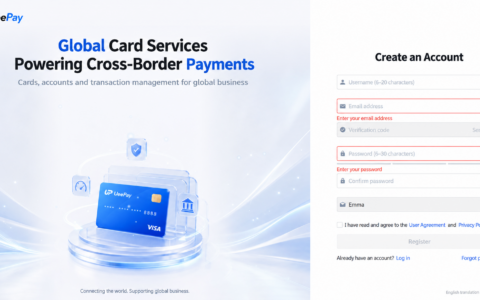
UeePay provides virtual card services for businesses and cross-border users making online payments to overseas merchants, subject to the provider's rules.
For example:
- Overseas advertising
- SaaS software
- AI tools
- Cloud services
- Overseas e-commerce
- Enterprise online purchasing
- Digital services
Support for a specific merchant or payment use depends on merchant rules, the card BIN, the transaction region, and the provider's current risk controls.
When choosing a corporate virtual card, focus on three areas:
Reliability
Frequent payment failures can disrupt overseas operations, so reliability matters.
Fit for the intended use
Card BIN requirements, authentication, and merchant risk controls may differ by payment use. Choose based on your actual business needs.
Compliant operations
Businesses using cross-border payment tools should consider KYC/KYB requirements, genuine transaction activity, and financial compliance.
16. Connect incoming payments with outgoing business spending
An established international trading company needs to manage both:
How are incoming payments received?
Overseas customers → Corporate cross-border collection account → Corporate bank account
How are outgoing payments made?
Corporate funds → Corporate virtual cards/cross-border payment tools → Overseas advertising, software, procurement and other service providers
Together, these form the following business cycle:
Acquiring customers overseas
↓
Customer places order
↓
Cross-border payment collection
↓
Business fund management
↓
Payments for overseas advertising, software, and procurement
↓
Order fulfillment
↓
Repeat purchases
This connects payment collection, fund management, and spending throughout the business cycle.
17. Start with your actual payment needs
For international trade, cross-border e-commerce, or overseas advertising, begin with your payment requirements rather than asking only:
“Which card is the cheapest?”
Clarify:
① Which platforms or merchants will you pay?
② How much will you spend each month?
③ In which countries will you make payments?
④ What currency is used?
⑤ Do you need 3DS?
⑥ Do you need to open cards in batches?
⑦ Can your company complete KYB verification?
Use these answers to select a corporate virtual card solution that fits your business.
For information about UeePay corporate virtual cards, card BIN selection, overseas advertising payments, batch card issuance, and cross-border payment options, explain your intended payment uses to the provider. Confirm support before selecting a card and plan.
👉 If you are interested, you can learn about UeePay:
UeePay registration
Choose a cross-border payment solution that fits your business needs.
本文由 VCCMap 虚拟卡指南整理,转载请注明出处:https://vccmap.com/en/%e5%a4%96%e8%b4%b8%e4%bc%81%e4%b8%9a%e5%a6%82%e4%bd%95%e9%80%89%e6%8b%a9%e8%b7%a8%e5%a2%83%e6%94%b6%e6%ac%be%e6%96%b9%e5%bc%8f%ef%bc%9f2026%e5%b9%b4%e5%a4%96%e8%b4%b8%e4%bc%81%e4%b8%9a%e6%94%b6-en/