
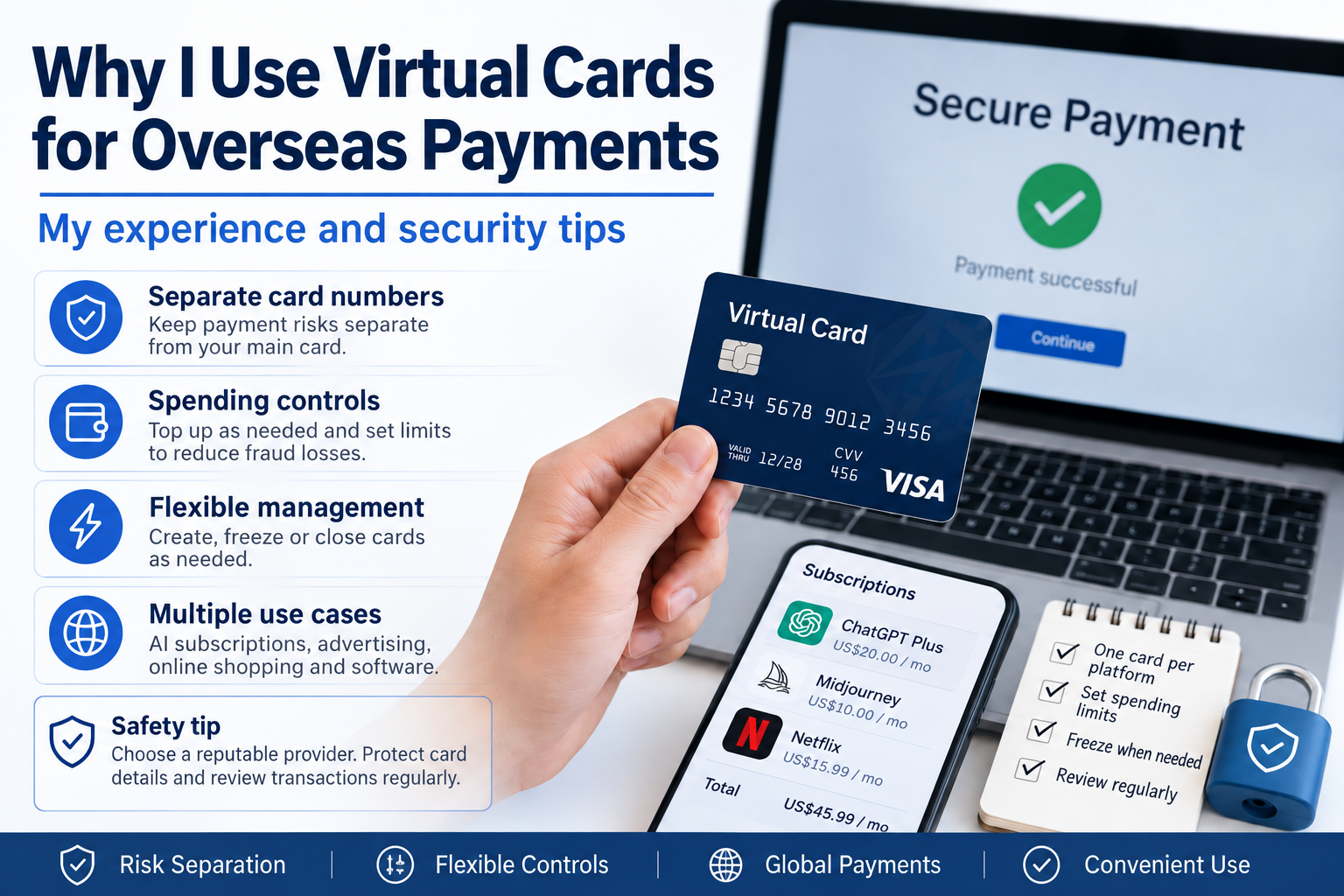
I used to think virtual cards were simply bank cards without a physical form, with nothing particularly special about them.
That changed last year, when I encountered several problems in succession.
The first involved an AI tool subscription.
I wanted to subscribe to ChatGPT Plus, but my domestic credit card kept returning payment errors. Trying several cards did not help. I later encountered similar problems with Claude and Midjourney, including risk checks and bank declines.
The second involved an overseas purchase.
After buying software from an overseas website, I noticed several unfamiliar small charges on my card. I contacted the bank and recovered the funds, but had to cancel and replace the card and update its linked payment methods. The process took several days.
That prompted me to investigate why so many people working in cross-border business use virtual cards.
After using them for more than half a year, my main takeaway is:
It is not only about being able to pay; it is also about paying more safely.
Separate cards help isolate risk
I previously used just one credit card.
I used it to buy software.
I used it for subscriptions.
I used it for advertising.
I also used it for overseas shopping.
A data leak or stolen card number on one platform could put that entire card at risk.
After switching to virtual cards, I adopted a different approach:
- One card for ChatGPT;
- One for advertising;
- One for overseas purchases;
- Another for software subscriptions.
An issue with one card then does not affect purchases made with the others.
This separation is particularly useful for people who make overseas payments frequently.
Spending limits give me more control
My physical credit cards had higher limits.
The possibility of a leaked card number made me uneasy.
Virtual cards generally allow users to add funds as needed or set spending limits.
For example:
My software subscriptions total about $50 a month.
I therefore add only $60 to the card.
This limits the potential loss from an unauthorized charge.
I feel more comfortable doing this than linking a credit card with a limit of tens of thousands of yuan directly to a service.
Replacing a card after a problem is more convenient
Once, after paying on an overseas website, I became concerned that the site was unreliable.
With a physical card, I might have needed to:
- Contact the bank;
- Report the card as compromised;
- Wait for a replacement;
- Update all linked payment details.
The process is inconvenient.
With a virtual card, the process is simpler.
I can deactivate the affected card and open a new one.
The process takes only a few minutes.
This is convenient for frequent users of overseas websites.
Why do people in cross-border business use virtual cards?
I later met many people working in cross-border e-commerce and advertising and noticed a common pattern:
They rarely rely on a single bank card.
The reasons are straightforward.
Different platforms apply different risk controls.
Different business activities also need separate budgets.
For example:
- One card for Facebook Ads;
- One for Google Ads;
- One for TikTok Ads;
- One for AI subscriptions;
- One for corporate purchases.
This makes reconciliation easier and reduces the effect of problems on one platform on other business activities.
Some companies assign a card to each project, making financial management clearer.
Are virtual cards 100% safe?
No.
No payment tool is completely safe.
Sharing your card number, CVV, or security code, or entering details on a phishing website, can still lead to theft.
Compared with exposing your primary bank card, virtual cards can help keep the potential risk more limited.
They act as an additional layer of separation.
An issue with one virtual card does not involve your primary card or other payment use cases.
Who can benefit most from a virtual card?
Based on my experience, virtual cards are particularly useful for people who:
- Regularly subscribe to ChatGPT, Claude, Gemini, or other AI tools;
- Make overseas purchases or payments for cross-border e-commerce;
- Run ads on Facebook, Google, TikTok, or similar platforms;
- Frequently buy overseas software or SaaS services;
- Shop overseas or pay for overseas memberships;
- Manage payments for multiple business projects or teams.
For occasional purchases on overseas websites, an ordinary bank card may be enough.
If overseas payments are part of your daily work, the convenience and security benefits of virtual cards become more apparent.
What to consider when choosing a provider
Many beginners ask, ‘Which platform is best?’
Rather than focusing only on low prices, I recommend checking:
- Support for your intended payment use cases;
- Risk controls and account security measures;
- The ability to open, freeze, and cancel cards quickly;
- Reliable customer support;
- Support for different BIN ranges and payment requirements.
I use UeePay for AI subscriptions, overseas software, and some cross-border payments. My overall experience has been relatively reliable, with a good payment success rate.
If your needs are similar, explore the options and choose a provider that fits your business use case.
本文由 VCCMap 虚拟卡指南整理,转载请注明出处:https://vccmap.com/en/%e4%b8%ba%e4%bb%80%e4%b9%88%e6%88%91%e7%8e%b0%e5%9c%a8%e5%87%a0%e4%b9%8e%e6%89%80%e6%9c%89%e6%b5%b7%e5%a4%96%e6%94%af%e4%bb%98%ef%bc%8c%e9%83%bd%e4%b8%8d%e7%94%a8%e5%ae%9e%e4%bd%93%e9%93%b6%e8%a1%8c-e/

