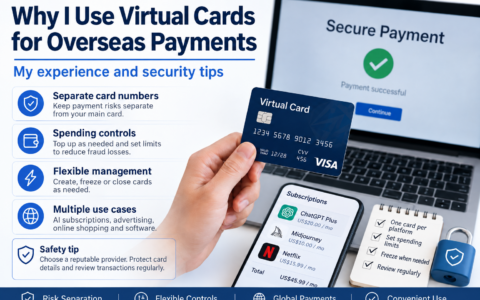
Are virtual credit cards safe? Can their details be used fraudulently? Why are more businesses and individuals using them? This article examines virtual card security features, common risks, fraud-prevention practices, and use cases to help you use virtual cards safely.
Introduction
With the growing demand for AI tool subscriptions, cross-border e-commerce, overseas SaaS services and international payments, virtual credit cards have become a payment tool for more and more individuals and businesses.
However, people who are new to virtual cards often have questions such as:
- Are virtual credit cards safe?
- Are virtual cards more vulnerable to fraud than physical bank cards?
- Why are so many businesses using virtual cards?
- What risks should I be aware of when using virtual cards?
In fact, virtual credit cards themselves are no more dangerous than physical bank cards. Choosing a legitimate card issuer and developing good payment habits can help you manage risks when using virtual cards for online purchases.
What is a virtual credit card?
A virtual credit card is a digital payment card with no physical form.
Like a physical card, it has:
- A card number
- An expiration date
- A CVV security code
- A cardholder name
It can therefore be used for most online payments in the same way as a regular bank card.
The difference is that virtual credit cards are usually managed through a web page or app, eliminating the need to wait for a physical card to be produced and mailed.
Why do many people think virtual credit cards are unsafe?
There are three main reasons.
Reason 1: There is no physical card
Many people think:
If there is no physical card, is it fake?
In fact, bank card payments rely on the card number, expiration date and security code rather than the plastic card itself.
As long as the payment network supports the card, online payments work on the same principles for virtual and physical cards.
Reason 2: Fear of fraud
You may occasionally encounter reports of virtual card fraud online.
In most cases, these incidents stem not from the virtual card itself, but from actions such as:
- Entering card information on a phishing website
- Using platforms from unknown sources
- Sharing sensitive information, such as a card number and CVV, with others
- Using a fake checkout page
These risks also apply to physical bank cards.
Reason 3: A failed payment is mistaken for a security problem
Some users mistakenly assume that a failed payment means their virtual card is not secure.
Payments can fail for many reasons, including:
- Merchant restrictions
- Issuer risk checks
- Failed address verification (AVS)
- Failed 3D Secure authentication
- An insufficient card balance
- A merchant that does not currently accept the card type
A failed payment does not mean there is a security issue with the card.
What are the security advantages of virtual credit cards?
1. Separate cards for different uses
For example:
- One card for AI software subscriptions
- One card for advertising
- One card for business purchases
- One card for overseas purchases
This separates payment details, so a data breach on one platform does not expose the cards used for other payments.
2. Set spending limits
Many virtual card platforms support:
- Per-transaction limits
- Daily spending limits
- Overall spending limits
This can reduce potential losses even if card information is leaked.
The available features depend on the card issuer; not every platform supports all of them.
3. Freeze or cancel cards quickly
If a card is suspected to be at risk, many platforms allow users to freeze, deactivate or cancel the card online without going to the bank.
Taking action online is usually more efficient than arranging a replacement physical card.
4. Manage business expenses more easily
Businesses can issue separate virtual cards for departments, projects, or employees. Department examples include:
- Marketing Department
- Technology Department
- Sales Department
- Purchasing Department
Each card is managed independently, helping with budget control and financial reconciliation.
What are the risks of virtual credit cards?
Although virtual credit cards have many advantages, you still need to be aware of the following risks.
Using unverified platforms
Choosing a platform that lacks appropriate credentials or has weak risk controls may put your funds and account security at greater risk.
Prioritize platforms with compliant operations, accessible customer support, and transparent information.
Paying on untrusted websites
Whether it is a virtual or physical card, avoid entering card information on websites from unknown sources.
Before paying, check the following:
- Is the website address correct?
- Does the website use an encrypted HTTPS connection?
- Is the merchant trustworthy?
Sharing card details
Do not send the following information to others:
- Card number
- CVV
- Expiration date
- SMS verification code
- One-time password (OTP)
Legitimate providers generally do not make unsolicited requests for these sensitive details.
How can you use virtual credit cards safely?
Make the following practices part of your routine.
Use separate cards
Use different cards for different purposes, for example:
- Software subscriptions
- Advertising costs
- Overseas shopping
Using separate cards makes payments easier to manage and reduces risk.
Check transaction records regularly
Review your transactions regularly and contact the card issuer immediately if you find any suspicious activity.
Turn on transaction notifications
Many platforms support SMS, email, or app push notifications.
Real-time notifications help you identify suspicious transactions promptly.
Set a reasonable limit
For a single service subscription, there is no need to set an unnecessarily high spending limit.
Appropriate spending limits can reduce unexpected losses.
Why are more and more people starting to use virtual credit cards?
Virtual card use cases have expanded in recent years. The main reasons include:
- Growing demand for AI software subscriptions
- Rapid growth in cross-border e-commerce
- Increased digital procurement by businesses
- Growing use of SaaS services
- Expansion of online advertising
- Wider adoption of online payments
For individual users, virtual credit cards make it easier to manage subscriptions and overseas payments.
For businesses, virtual cards help improve expense management, budget control, and financial reconciliation.
Frequently Asked Questions (FAQ)
Q1: Can virtual card details be used fraudulently?
Fraud is possible, but it is not unique to virtual cards. Choosing a legitimate provider, protecting card details, and enabling transaction notifications can help reduce the risks.
Q2: Are virtual credit cards safe?
Virtual credit cards from legitimate issuers generally use the same payment networks and security standards as physical bank cards. Security depends both on the card and on how you use it.
Q3: Who are virtual credit cards suited to?
They can be suitable for:
- Individual users who frequently subscribe to overseas software
- Cross-border e-commerce sellers
- Advertising teams
- Corporate purchasing departments
- Users who frequently make international online payments
Q4: Can virtual credit cards completely replace physical bank cards?
Not completely. Virtual credit cards are mainly suited to online payments, while physical bank cards still have advantages for ATM withdrawals and some in-person purchases.
Summary
A virtual credit card is not inherently an "unsafe" payment method. It is a digital payment card designed for online transactions.
For people who frequently make cross-border payments, subscribe to AI tools, or make business and other online purchases, careful use of virtual cards can improve payment efficiency and offer more flexible fund management. Separate cards, spending limits, and quick deactivation can also help reduce risk.
Whether you use a virtual or physical card, choosing a legitimate issuer, protecting account information, and keeping card details off untrusted websites remain essential payment-security practices.
本文由 VCCMap 虚拟卡指南整理,转载请注明出处:https://vccmap.com/en/%e8%99%9a%e6%8b%9f%e4%bf%a1%e7%94%a8%e5%8d%a1%e5%ae%89%e5%85%a8%e5%90%97%ef%bc%9f%e4%b8%ba%e4%bb%80%e4%b9%88%e8%b6%8a%e6%9d%a5%e8%b6%8a%e5%a4%9a%e4%ba%ba%e5%bc%80%e5%a7%8b%e4%bd%bf%e7%94%a8%ef%bc%9f-4/