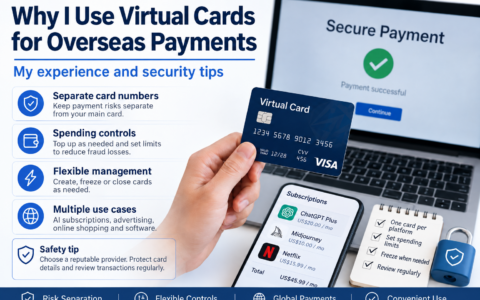
In recent years, more businesses have used virtual cards for cross-border e-commerce, overseas advertising, SaaS subscriptions, AI tools, and other overseas payments.
Virtual cards can help with overseas online payments, advertising charges, and software subscriptions. However, users are increasingly concerned about providers disappearing, sudden shutdowns, unavailable withdrawals, and unresponsive customer support.
With some small virtual card providers, easy registration, convenient funding, and fast card issuance can lead users to overlook a key question:
Whether the card can be used normally is one thing, but whether the platform itself is safe is another.
When choosing a virtual card, consider more than issuance fees and payment success rates. Also examine fund management, card issuance channels, compliance processes, customer support, and arrangements for ending the service.
1. Can a virtual card provider disappear?
Yes, but different situations need to be distinguished.
Some providers suffer operational failures or cash-flow problems and cannot continue providing services. Others suspend or end operations because of changes involving upstream card issuers, payment institutions, or compliance requirements.
For example, in the past few years, there have been some cases in the industry where virtual card businesses have voluntarily withdrawn and stopped services, and some platforms have terminated related businesses due to regulatory, compliance or upstream reasons.
This means:
A shutdown does not necessarily mean fraud or that a provider has absconded. However, it can still interrupt services, so managing financial risk in advance is important.
If users leave large balances in platform accounts for long periods, operational or compliance problems can create serious uncertainty about how quickly funds will be processed and whether withdrawals will be completed.
A previous Southern+ report on virtual credit cards also noted that users may fund accounts with large amounts in advance while spending only part of the balance. This leaves unused funds on the platform, which may be difficult to recover if operational problems arise.
2. Why are virtual card platforms prone to business risks?
1. The platform’s own financial pressure
A virtual card provider must handle card issuance, funding, settlement, refunds, chargebacks, and risk management.
A small provider handling substantial transaction volumes may face liquidity pressure if large refunds, chargebacks, or upstream fund freezes occur.
For users, the most dangerous thing is not that a card suddenly becomes unusable, but that:
There is still a large balance in the account.
A card that stops working is usually an operational issue.
An unavailable withdrawal can become a financial problem.
2. Over-reliance on a single upstream channel
Many users ask only, “Does this BIN work with Facebook Ads?” or “Can this card pay for AI subscriptions?” They overlook the issuer and payment channel behind the card.
If a provider depends heavily on one card issuer, changes to that issuer’s business, suspended transaction types, or an ended partnership may affect many cards.
Therefore:
A provider’s core strengths depend not just on its number of card BINs, but also on payment infrastructure, compliance processes, and risk management.
3. Low-price competition may hide business risks
Offers such as “0 issuance fee,” “ultra-low processing fees,” “funding bonuses,” and “large ongoing rebates” can look attractive.
But users need to think about a question:
How does the platform make money?
Be cautious if a payment provider consistently prices its services well below typical industry costs while offering substantial funding discounts.
Low prices can be helpful, but if they seem commercially unsustainable, examine the provider’s business model more closely.
3. What warning signs should users watch for?
A few warning signs cannot prove that a provider will disappear, but the following situations deserve attention.
Signal 1: Withdrawal suddenly becomes difficult
For example:
- Withdrawal review times are getting longer and longer;
- Customer support repeatedly asks users to wait;
- Withdrawals are suddenly disabled;
- Refunds are not received for a long time;
- Customer support offers only explanations such as “system upgrade” or “under review by the bank.”
If several problems occur together, reduce the balance held on the platform and avoid adding large amounts.
Signal 2: Customer support and official channels become unreliable
Normally operating platforms usually maintain basic customer service and announcement systems.
Watch for sudden changes such as:
- The official group is closed;
- Customer service does not reply for a long time;
- Official announcements stop being updated;
- Support tickets go unanswered;
- The website is frequently inaccessible;
- Users suddenly cannot log in to the app;
Monitor the provider’s status promptly when these problems arise.
In July 2026, public industry reports described failed payments and transfer problems reported by users of a virtual card platform, alongside prolonged inactivity in its official community and customer support channels. These are third-party reports. Users should consult official announcements and actual fund-processing outcomes when assessing a specific provider.
Signal 3: A sudden push for large account deposits
This is a situation that deserves vigilance.
For example, the platform suddenly launched:
“The more you add, the more rewards you receive.”
“Add tens of thousands of dollars at once and receive a bonus balance.”
“Add funds and receive cashback. Last day of this limited-time offer.”
Users should add funds according to actual spending needs rather than deposit large amounts in advance for so-called “discounts.”
Funding discounts do not establish that a provider is safe.
Signal 4: Platform rules are frequently modified
Watch for frequent changes over a short period to:
- Withdrawal rules;
- Processing fees;
- Funding rules;
- Card usage restrictions;
- KYC requirements;
- Refund rules;
In particular, pay close attention to sudden increases in withdrawal restrictions.
4. The most dangerous behavior: putting a large amount of funds on the virtual card platform for a long time
What many users do is:
US$10,000 is added to an account → only US$500 is spent in a day → the remaining US$9,500 stays on the platform for a long time.
The main risk is leaving unused funds tied up on the platform.
If you are only going to spend $500 today, why should you top up $10,000 in advance?
A more reasonable way should be:
Add funds in smaller batches according to actual spending needs to minimize the balance held on the platform.
For example:
If expected advertising spending for today is 300 US dollars, prepare a reasonable amount for that need rather than deposit tens of thousands of dollars at once for so-called discounts.
In this way, even if the platform suddenly fails, the risk exposure is relatively limited.
5. How to judge whether a virtual card platform is worthy of long-term use?
Assess a provider using the following criteria.
① Whether KYC/KYB is required
Formal payment businesses usually focus on customer identification and transaction risk management.
“No identity verification required” does not necessarily mean a provider is more convenient.
For business users, established business verification, identity checks, and compliance reviews generally indicate that a provider has some compliance management processes.
② Are there clear terms of service?
Before registering, you can focus on:
- Funding rules;
- Withdrawal rules;
- Refund rules;
- Card cancellation rules;
- Disputed transaction rules;
- Risk management rules;
- Supported and restricted payment use cases.
If there are no basic rules, it will be difficult for users to judge their rights and interests.
③ Are supported use cases clear?
Not every virtual card can be used for every purpose.
Advertising, AI subscription, SaaS software, cloud servers, overseas e-commerce, games, travel and other scenarios may have different card BIN, MCC, 3DS, billing address and risk control requirements.
Therefore, do not ask only, “Can this card be used?” Ask, “Which payment use cases is this card suited to?”
④ Is reliable customer support available?
Virtual cards are payment products.
Timely customer support is important when unexpected charges, refunds, chargebacks, or card freezes occur.
A provider operating for the long term should have a reasonably clear process:
Customer support → Support ticket → Risk review → Follow-up resolution.
6. When choosing a virtual card, don’t just look at the “success rate”
When many people choose a virtual card platform, the first thing they say is:
"What's the success rate of your card?"
Success rate is certainly important, but it is by no means the only metric.
A successful payment today does not guarantee that the provider will still operate reliably in six months.
What really deserves attention is:
Payment capabilities + fund security + upstream reliability + compliance processes + customer support.
For companies that engage in long-term advertising, cross-border e-commerce or AI/SaaS subscriptions, stability is often more important than simply being a few dollars cheaper.
7. What should you do if a provider appears to be in trouble?
If problems appear on a virtual card platform, avoid adding more funds.
Consider the following steps:
Step 1: Stop adding funds.
Do not keep adding money just because customer support promises an “immediate recovery.”
Step 2: Organize account information.
Save account balances, funding records, transaction records, refund records, withdrawal records, and customer support conversations.
Step 3: Try to withdraw the remaining balance.
If the platform is still open for withdrawals, priority should be given to fund withdrawals.
Step 4: Cancel unnecessary subscriptions.
If the card is linked to recurring charges for advertising platforms, AI tools, or SaaS services, promptly review and cancel subscriptions you no longer need.
Step 5: Pay attention to the official announcement.
Determine whether the issue involves system maintenance, an upstream channel change, a service suspension, or a complete shutdown.
8. A long-term approach: Do not rely on a single provider
For businesses with ongoing overseas payment needs, the safest approach is not to search for a “provider that will never have problems.”
Any payment platform may be affected by:
- Changes at upstream institutions;
- Changes in card network policies;
- Changes in risk control policies;
- Compliance requirements;
- Merchant rules;
- Market conditions;
Other factors may also affect payment platforms.
A more reasonable way is:
Choose a relatively reliable provider + diversify fund exposure + add funds according to actual needs + avoid holding large balances for long periods + prepare backup payment methods.
This is the more secure way to use virtual cards for a long time.
Conclusion
When choosing a virtual card platform, don’t just look at:
Whether the price is low, card issuance is fast, and the payment success rate is high.
You should also pay attention to:
Whether the platform is stable, whether the underlying channels are reliable, whether the rules are transparent, whether funds can be withdrawn normally, whether the customer service is complete, and whether a basic compliance system is in place.
The virtual card industry is still changing. For corporate users, instead of waiting until there is a problem with the platform, it is better to consider the safety of funds and backup plans on the first day of choosing a platform.
Choosing a virtual card and making a successful payment are only the first steps. Provider reliability and fund security matter for long-term use.
Virtual card enquiries
If you are looking for a reliable virtual card provider or need help with failed payments, BIN selection, or risk checks for overseas advertising, AI subscriptions, SaaS subscriptions, cross-border e-commerce, or overseas online payments, you can contact me.
I can help you assess a suitable virtual card solution based on your payment use cases, regions, and usage needs.
I recommend the following provider, which I have been using for more reliable payments:
UeePay📌 Official website registration: https://ueepay.com/register?invite_code=Emma
📩 Telegram:@XK726
You can also contact me to discuss card BIN selection, use-case compatibility, API-based card issuance, and reseller partnerships.
Reminder: Card BINs and payment channels support different use cases. Transaction outcomes may depend on the merchant, region, account, browser, funds, and risk checks. Choose a card based on your actual needs.
本文由 VCCMap 虚拟卡指南整理,转载请注明出处:https://vccmap.com/en/%e8%99%9a%e6%8b%9f%e5%8d%a1%e5%b9%b3%e5%8f%b0%e4%b8%ba%e4%bb%80%e4%b9%88%e4%bc%9a%e8%b7%91%e8%b7%af%ef%bc%9f2026%e5%b9%b4%e8%99%9a%e6%8b%9f%e5%8d%a1%e8%b5%84%e9%87%91%e5%ae%89%e5%85%a8%e4%b8%8e-en/