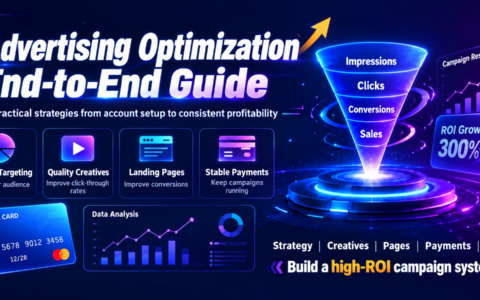
Advertising is an important customer-acquisition channel for cross-border e-commerce, independent online stores, apps, games, and other overseas businesses.
Many advertisers, however, face several questions:
When should ads run? How much should you spend each day? Why do the same creatives convert well for others while you keep losing money? Why does an ad account charge fail even though there is a balance?
Advertising involves more than adding funds, launching ads, and waiting for customers.
Campaign performance depends on the audience, schedule, creatives, budget allocation, landing page, payment method, and ongoing data-driven optimization.
1. How should you plan an advertising campaign?
A complete campaign workflow can be summarized as:
Define the goal → Choose the platform → Identify the audience → Create ads → Test with a small budget → Analyze data → Optimize → Scale up
1. First determine the advertising goals
Different businesses have different campaign goals.
For example:
- E-commerce: focus on purchases, ROAS, and CPA
- Independent online stores: focus on add-to-cart events, payments, and purchase conversions
- Apps: focus on downloads, registrations, and payments
- SaaS: focus on registration, trial, and subscription
- Brand promotion: focus on exposure, clicks, and search growth
- B2B businesses: focus on inquiries, form submissions, and qualified leads
Don’t just focus on “clicks” from the beginning.
More clicks do not necessarily mean more profit. What matters is whether those clicks lead to meaningful conversions.
2. Do not commit the entire budget at the start
A common beginner mistake follows this pattern:
Launch a campaign → Start with a large budget → See poor results → Make drastic adjustments → Exhaust the budget
A more reasonable approach is to test first.
For example, a US$100 daily test budget could be allocated as follows:
- $30 to test creative A
- $30 to test creative B
- $20 to test creative C
- $20 to test different audiences
Once you have collected data, shift more of the budget to better-performing ad groups.
Key metrics during testing include:
CTR, CPC, CPM, CVR, CPA, ROAS
Interpret them in context:
Low CTR: Check the creative, headline, and audience.
High CPC: Competition may be strong, the creative may lack appeal, or the audience targeting may be unsuitable.
Many clicks but no conversions: Review the landing page, product price, checkout process, and audience targeting.
High CPA: The current acquisition cost may not be sustainable for your business model, so further optimization is needed.
3. When is the best time to run ads?
This is the biggest concern for many advertisers.
But please note:
There is no “prime time” that suits all industries.
The best campaign schedule varies by country, platform, industry, and audience.
For example:
- B2B customers: Inquiries may be more likely to occur during working hours
- E-commerce: There may be more shopping during lunch breaks and evenings
- Gaming: users may be more active in the evenings and on weekends
- SaaS: Weekdays may be more likely to generate signups
- Content products: Users may have more free time at night
Time periods to test when you have no historical data
Morning: 07:00-10:00
Use this window to test audiences who are active before work, while commuting, or in the morning.
Noon: 11:30-14:00
This window can be tested for e-commerce, content, everyday services, and other use cases.
Evening: 18:00-23:00
Many consumer-facing businesses can focus their tests on this window.
These are starting points for testing, not fixed answers.
A practical approach is:
Run ads throughout the day → Collect 7-14 days of data → Identify the lowest-cost conversion windows → Allocate more budget to those windows
4. Account for time zones in overseas campaigns
Scheduling is especially important when targeting overseas markets such as the United States, the United Kingdom, Canada, or Australia.
For example, if your advertising account is in one time zone, but your target customer is in another time zone, then the "8pm" you see may not necessarily be the customer's local 8pm.
Ad schedules must account for the difference between the account time zone and the target audience time zone.
When running overseas campaigns, analyze performance according to:
The target audience local time.
This provides a more useful basis for comparing campaign results.
For example:
The U.S. market should not simply judge "evening prime time" based on Beijing time.
If you target regions such as the eastern and western United States simultaneously, break down the data further by region and local time.
5. Do not judge campaigns by one day of data
Avoid reactions such as:
Results are poor this morning, so stop the campaign immediately.
Results are good this afternoon, so increase the budget immediately.
This can easily lead to misjudgment.
New ads, creatives, and audiences in particular need enough data before you can assess them.
Review the full conversion journey, including:
Click → Add to cart → Register → Pay → Complete the purchase
Consider the entire journey, not just one stage.
For example, one ad may have:
A relatively high cost per click but a strong final purchase conversion rate.
Another ad may have:
A very low cost per click but no orders.
If you only look at the CPC, you may mistakenly think that the second ad is better.
Final conversions, rather than clicks alone, determine profit.
6. When should you increase your budget?
Once an ad generates consistent conversions, consider scaling it gradually.
For example:
First stage:
$50/day → Test
Second stage:
$70-100/day → Validate performance
Third stage:
$150-200/day → Scale up
Do not repeatedly double the budget just because ROI is strong on one day.
Rapid budget changes may alter the traffic mix and ultimately increase costs.
7. Ad creatives matter more than you may think
For the same product, consider these results:
Creative A has a 2% click-through rate.
Creative B has a 5% click-through rate.
Even if the product and audience are exactly the same, the final advertising cost can be significantly different.
Do not rely on just one set of creatives.
Consider testing:
3-5 sets of creatives using different approaches.
For example:
Creative A: Address a pain point
“What should I do if my Facebook ad suddenly fails to charge?”
Creative B: Focus on outcomes
“How to reduce overseas advertising customer acquisition costs?”
Creative C: Use a case example
"With the same budget, why can others achieve higher ROI?"
Creative D: Present the product
Directly introduce product features and benefits.
Creative E: Focus on a use case
Target a specific industry, country or user group.
Use the results to determine which approach fits your audience.
8. The most easily overlooked aspect of advertising: payment
Many advertisers think:
An ad account balance means every charge will succeed.
Not necessarily.
Advertising payment acceptance may also depend on:
- Card type
- Card BIN
- Card issuance region
- Account region
- IP address
- Billing address
- Account history
- Payment risk checks
- 3DS authentication
- Merchant risk controls
- Card balance
Other factors may also affect acceptance.
For ongoing overseas campaigns, arrange a reliable, compliant payment method that fits the payment region and use case in advance. Do not wait for a failed charge to interrupt a running campaign.
9. Why might an ad suddenly stop performing?
Common reasons include:
1. Creative fatigue
Repeatedly showing the same creative can overexpose users to it, reducing click-through and conversion rates.
2. The audience is too narrow
A very small audience can lead to excessive ad frequency.
3. Increased competition
As the number of advertisers in the same market increases, CPM and CPC may increase.
4. Poor landing-page conversion
Users may click the ad but encounter problems on the website:
Slow loading, confusing pages, unclear prices, or a complicated checkout.
These problems can cause many users to leave.
5. Checkout payment problems
If an ad brings users to the site but their payments fail, overall ROAS also falls.
10. Build a campaign performance tracking table
Record at least the following each day:
| Metric | What to review |
|---|---|
| Spend | Daily advertising spend |
| Impressions | How much exposure the ads received |
| CPM | Cost per thousand impressions |
| Clicks | How many visits the ads generated |
| CTR | How often users clicked |
| CPC | Cost per click |
| Add to cart | Product appeal |
| Registrations | User intent |
| Purchases | Final conversions |
| CPA | Customer acquisition cost |
| ROAS | Return on advertising spend |
Break down the data by:
Country × Platform × Creative × Audience × Time period
Analyze each combination.
This helps you identify:
The best-performing audiences, creatives, and time periods, and the most profitable countries.
11. Knowing when to increase spending matters more than finding a single best time
This is something that many novices tend to misunderstand.
Experienced advertisers do not simply look for:
A single prime time.
Instead, they use data to find:
The right audience + the right creative + the right time period + a suitable payment method.
For example, you may eventually find:
US users convert best between 19:00 and 23:00, one creative has the highest CTR, and one ad group has the lowest CPA.
Then you can focus more budget on this combination.
This is more targeted than distributing spend evenly across all ads throughout the day.
Use historical performance by date and time to guide bid adjustments and further optimization.
12. A practical formula for campaign performance
The campaign process can be summarized as:
Strong creative × relevant audience × suitable timing × quality landing page × reliable payments = better campaign performance
Do not rely on spending more to solve every problem.
A larger budget amplifies results; it does not fix a poor campaign strategy.
If a campaign is not working, a larger budget may simply increase losses faster.
A cautious approach is:
Test with a small budget → Find strong combinations → Control costs → Establish consistent conversions → Scale gradually
For overseas advertisers, planning should cover not only campaign strategy, but also payment reliability, card BIN compatibility, account region, and compliant operations.
If you run Facebook Ads, TikTok Ads, or other overseas campaigns, choose a business payment card that fits your intended use. You can also review UeePay and assess its card options against your campaign country, platform, and payment needs.
👉 If you are interested, you can learn about UeePay:
本文由 VCCMap 虚拟卡指南整理,转载请注明出处:https://vccmap.com/en/%e5%b9%bf%e5%91%8a%e6%8a%95%e6%b5%81%e8%af%a5%e6%80%8e%e4%b9%88%e6%8a%95%ef%bc%9f%e4%bb%80%e4%b9%88%e6%97%b6%e9%97%b4%e6%ae%b5%e6%95%88%e6%9e%9c%e6%9c%80%e5%a5%bd%ef%bc%9f%e4%b8%80%e7%af%87%e8%ae%b2-e/