Businesses often think of procurement as buying products or services. For procurement managers, however, making the payment can be as challenging as choosing what to buy.
Cross-border businesses may encounter problems such as:
- Failed card payments for international software.
- Declined transactions for servers or domain names.
- Difficulty paying for team subscriptions to ChatGPT Plus, Claude Pro, or Notion AI.
- Risk checks when using international cards on Alibaba, AliExpress, or Amazon Business.
The problem is not always an insufficient balance. The payment method may not meet the platform’s requirements.
This is one reason businesses consider virtual cards for procurement.
What is a virtual card for business purchasing?
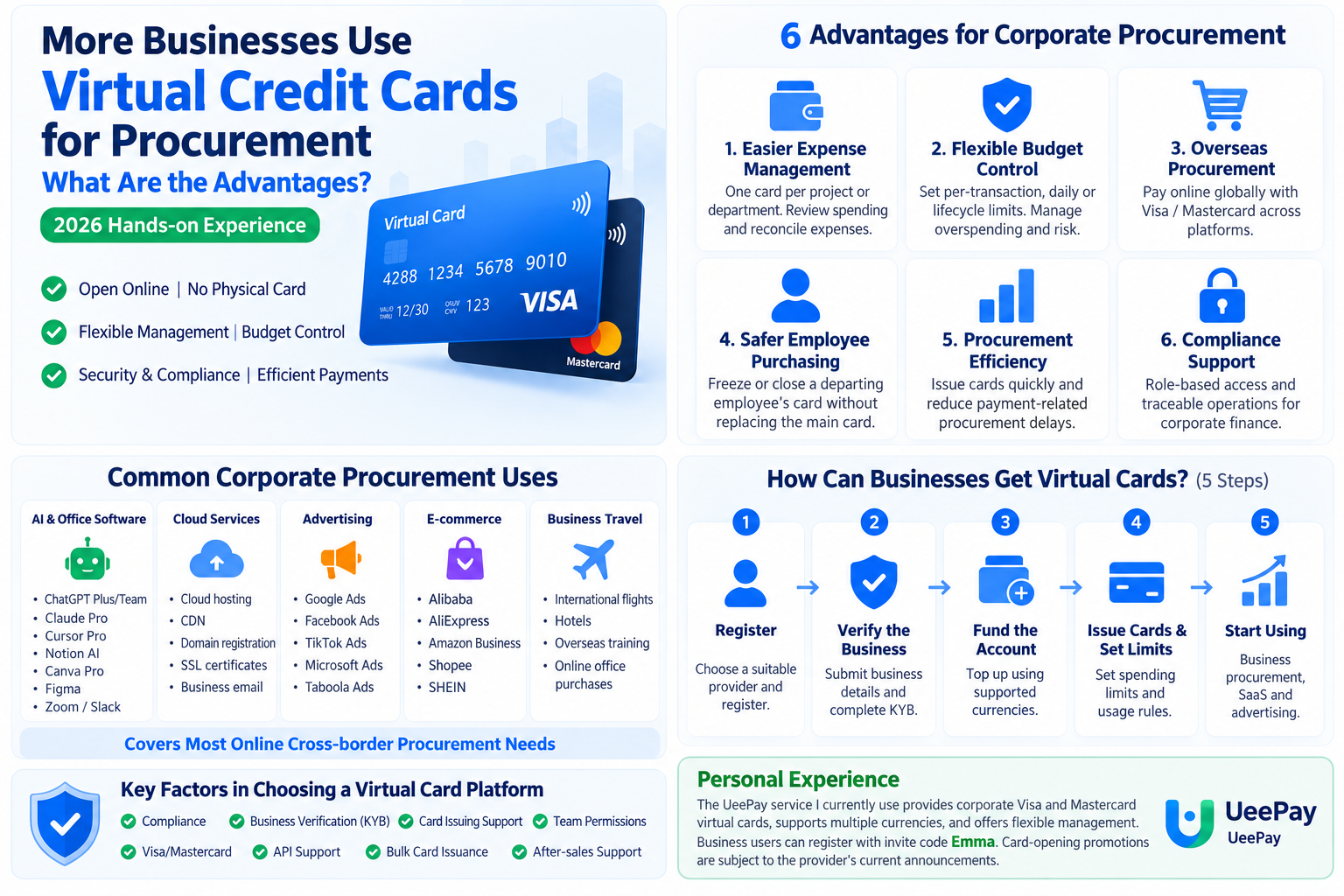
A virtual card for business purchasing provides Visa or Mastercard payment details without a physical card.
It has a card number, expiry date, and CVV for online payments, much like a regular card.
Features commonly associated with virtual cards include:
- Online applications without physical card delivery.
- On-demand issuance and management of multiple cards.
- Spending limits.
- Centralized management of purchasing expenses.
- Separate cards for business activities, departments, or employees.
These features can make payment management easier for frequent international purchases.
Why do businesses use virtual cards for procurement?
1. Easier expense tracking
A traditional business card may be shared by several people. Software, advertising, server renewals, and office purchases then appear together, making month-end reconciliation difficult.
Virtual cards allow separate allocation by project or department. For example:
- The IT department uses a card for servers.
- The marketing department uses a card for advertising.
- The AI team uses a card for ChatGPT, Claude, and Cursor subscriptions.
- The finance team reviews each card’s transaction records.
This simplifies expense tracking and reduces manual checks.
2. Flexible budget controls
Many providers offer per-transaction limits, daily limits, total spending limits, and expiry settings.
For example, if an employee has a monthly purchasing budget of $300, the business can create a card with a $300 limit. The limit helps control spending if the card details are exposed.
3. Support for international online purchasing
Common online business purchases include SaaS subscriptions, AI tools, servers, CDN services, cloud resources, domain registration, business email, and advertising funding.
Many of these platforms accept Visa and Mastercard payments. A suitable virtual card can help businesses organize those payments and reduce procurement delays.
4. Separate card management when employees leave
An employee’s business card may remain linked to several software subscriptions after they leave. Updating payment methods can take time and affect continuity.
With separate virtual cards, a business can freeze or cancel the affected card and issue a replacement without changing its main payment account.
Common business purchasing uses
AI and office software subscriptions
- ChatGPT Plus/Team
- Claude Pro
- Cursor Pro
- Notion AI
- Canva Pro
- Figma
- Zoom
- Slack
Cloud services
- Cloud servers
- CDN services
- Domain names
- SSL certificates
- Business email
Advertising and marketing
- Google Ads
- Facebook Ads
- TikTok Ads
- Microsoft Ads
- Taboola Ads
Cross-border e-commerce
- Alibaba
- AliExpress
- Amazon Business
- Shopee
- SHEIN
Business travel and training
- International hotel bookings
- Business flights
- International training courses
- Online office software
These examples cover many online cross-border purchasing needs.
How should a business choose a provider?
Review the following:
- Compliance credentials.
- Visa and Mastercard support.
- Business identity verification (KYB).
- API access.
- Bulk card issuance.
- Team access permissions.
- Multi-currency settlement.
- Customer support.
For large-scale purchasing, also check bulk management, automatic funding, and spending data exports.
Which provider do I use?
I use UeePay as an example. It offers business virtual Visa and Mastercard services for procurement, advertising, and software subscriptions. The features described here include API integration, bulk card issuance, and team management for cross-border business payments.
Business users can register with invitation code Emma. This article mentions a free card opening promotion for businesses; refer to the provider’s latest announcement for the specific offer and eligibility.
Summary
Cross-border procurement includes more than goods. Software subscriptions, cloud services, advertising, and AI tools are also important business expenses.
Virtual cards can offer advantages in budget management, payment organization, risk separation, and team collaboration.
Choose a product suited to your business needs to make international purchasing more organized and efficient.
本文由 VCCMap 虚拟卡指南整理,转载请注明出处:https://vccmap.com/en/%e4%bc%81%e4%b8%9a%e9%87%87%e8%b4%ad%e8%b6%8a%e6%9d%a5%e8%b6%8a%e5%a4%9a%e4%ba%ba%e5%bc%80%e5%a7%8b%e7%94%a8%e8%99%9a%e6%8b%9f%e4%bf%a1%e7%94%a8%e5%8d%a1%ef%bc%8c%e5%88%b0%e5%ba%95%e6%9c%89%e4%bb%80-e/