"My ads were running normally yesterday, but today I suddenly saw Payment Failed."
This is a problem that many Facebook Ads advertisers encounter.
For cross-border e-commerce sellers, online store operators, and advertising agencies, a failed Facebook Ads charge can mean:
- Ads stop running
- Traffic is interrupted
- Conversions drop
- Sales are directly affected
A common first question is:
Has my advertising account been blocked?
Based on extensive advertising experience, most Payment Failed messages indicate a problem in the payment process rather than with the advertising account itself.
This article examines Facebook Ads payment failures through official rules, real-world cases, and payment-management practices.
What does "Payment Failed" mean in Facebook Ads?
Payment Failed means:
Facebook attempted to charge your payment method, but the payment could not be completed.
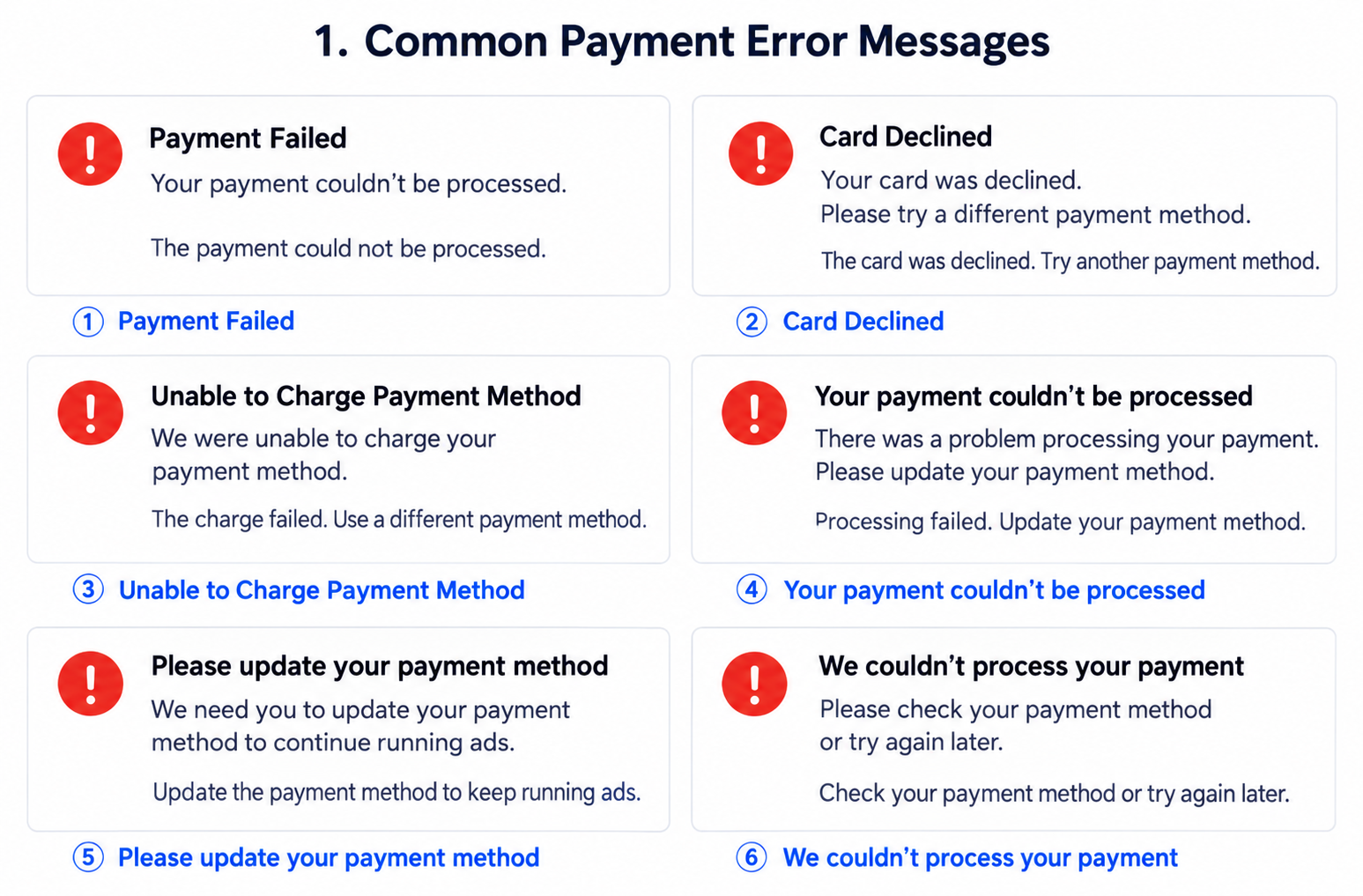
Common messages include:
- Payment Failed
- Card Declined
- Unable to Charge Payment Method
- Your payment couldn't be processed
- Please update your payment method
- We were unable to charge your card
The wording varies, but the meaning is the same: the platform could not complete the charge.
Why do Facebook Ads payments fail?
Here are some of the most common reasons.
1. Banks refuse cross-border transactions
This is the most common situation.
For example:
- Overseas payments are disabled by default
- The bank's risk system blocks cross-border transactions
- The bank considers the transaction risky
- Card issuers limit spending on advertising platforms
Enabling overseas payments on your card does not guarantee that a Facebook Ads charge will go through.
2. Insufficient card balance
Facebook does not charge your card immediately after every ad click.
Charges are typically initiated when:
- The billing threshold is reached
- The billing date arrives
- Accumulated advertising costs reach a specified amount
The accumulated costs are then charged together.
If the balance is insufficient at this time, the following will appear:
Card Declined
3. Incorrect payment information
Examples include:
- An incorrect CVV
- An incorrect card number
- An incorrect expiration date
- A cardholder name that does not match the bank's records
- A billing address that differs significantly from the issuer's records
Although not every issuer verifies billing addresses strictly, accurate details can help reduce payment errors.
4. Bank risk checks
The following activity may trigger a bank's risk checks:
- Multiple charges in one day
- Changing payment methods several times within a short period
- Linking many advertising accounts to the same card
- Logins from unusual countries or regions
- Transactions with merchants classified as high risk
If a risk check blocks the transaction, payment may fail despite a sufficient balance.
5. Facebook payment risk reviews
Meta also has its own risk-checking systems.
For example:
- A newly registered ad account immediately incurs high advertising spend
- Repeatedly adding different bank cards
- Frequent changes in payment methods
- An ad account has a history of policy violations
These factors may lead to stricter payment reviews.
6. Card issuers restrict advertising payments
Some bank cards or BIN ranges may have restrictions on merchant types.
For example:
- Advertising is not supported
- International digital services are not supported
- Subscription merchants are not supported
So even if a card works for everyday purchases, it may not work for Facebook Ads.
How can you troubleshoot the problem quickly?
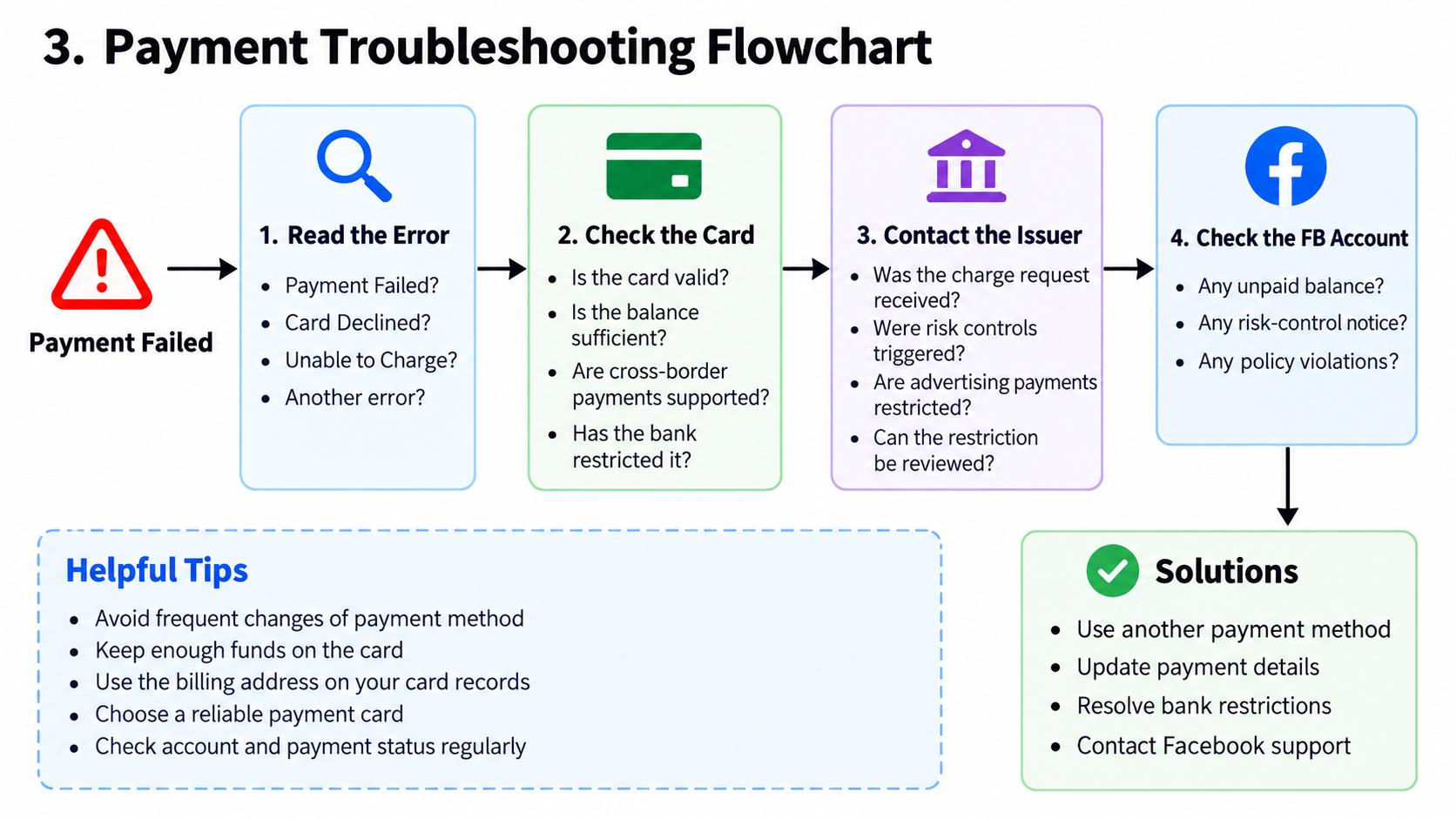
It is recommended to check in the following order.
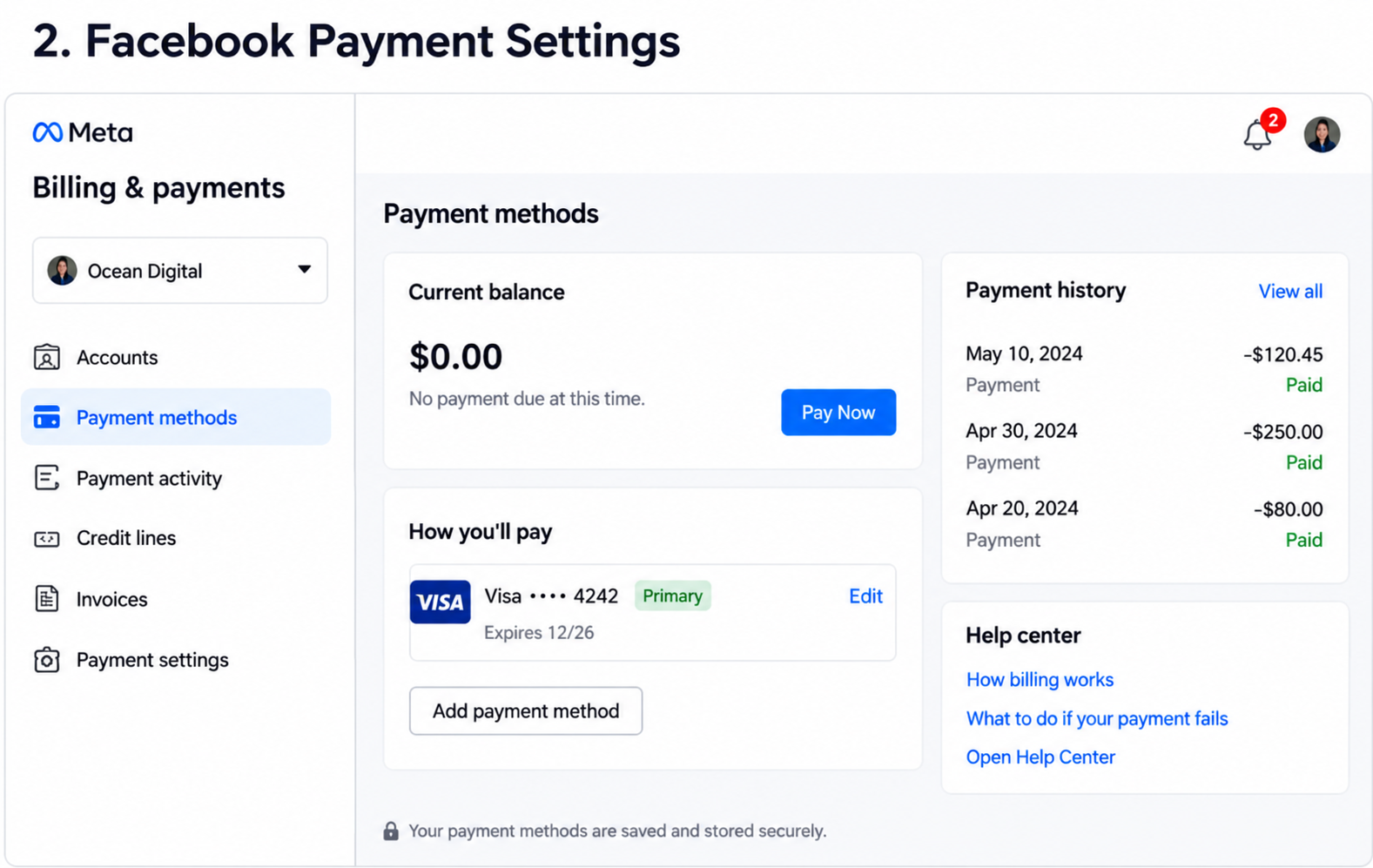
Step 1: Check for Facebook alerts
Go to:
Billing → Payment Settings
Check the specific error message.
The appropriate next step depends on the error message.
Step 2: Confirm bank card status
Check the following:
- Is the card frozen?
- Is it expired?
- Is the balance sufficient?
- Does it support international Visa or Mastercard payments?
- Are cross-border payments enabled?
Step 3: Contact the card-issuing bank
Confirm with your bank:
- Did the bank receive a payment authorization request from Facebook?
- Was the transaction blocked by a risk check?
- Are transactions on advertising platforms restricted?
- Does the bank need to remove a restriction manually?
Step 4: Check your ad account
Check for:
- Unpaid bills
- Risk notifications from Meta
- A history of account policy violations
Step 5: Avoid changing payment methods frequently
After a payment failure, some advertisers respond by switching cards repeatedly:
They try one card today;
Then another card tomorrow.
This may increase the likelihood of a payment review.
It is recommended to confirm the reason for the failure first before deciding whether to change the payment method.
Real-world cases
Case 1: An online store operator
An online store operator ran 12 Facebook ad accounts at the same time.
To simplify management, the operator linked every account to the same bank card.
One day, the bank's risk checks blocked cross-border charges on the card.
As a result:
- Ads stopped running across all 12 accounts;
- Orders generated by advertising dropped significantly that day;
- The team spent considerable time resolving payment issues.
The team then assigned a separate payment card to each advertising account and managed budgets individually. A problem with one card would no longer interrupt payments for the other accounts.
Case 2: Advertising agency
An advertising agency managed Facebook ads for several clients.
All clients initially shared the same payment account, making month-end reconciliation difficult.
The agency later adopted the following setup:
- A separate card for each client;
- Separate payments for each advertising account;
- Advertising expenses tracked by card number.
This improved management efficiency and reduced the risk of one payment problem affecting several clients.
How can you make Facebook Ads payments easier to manage?
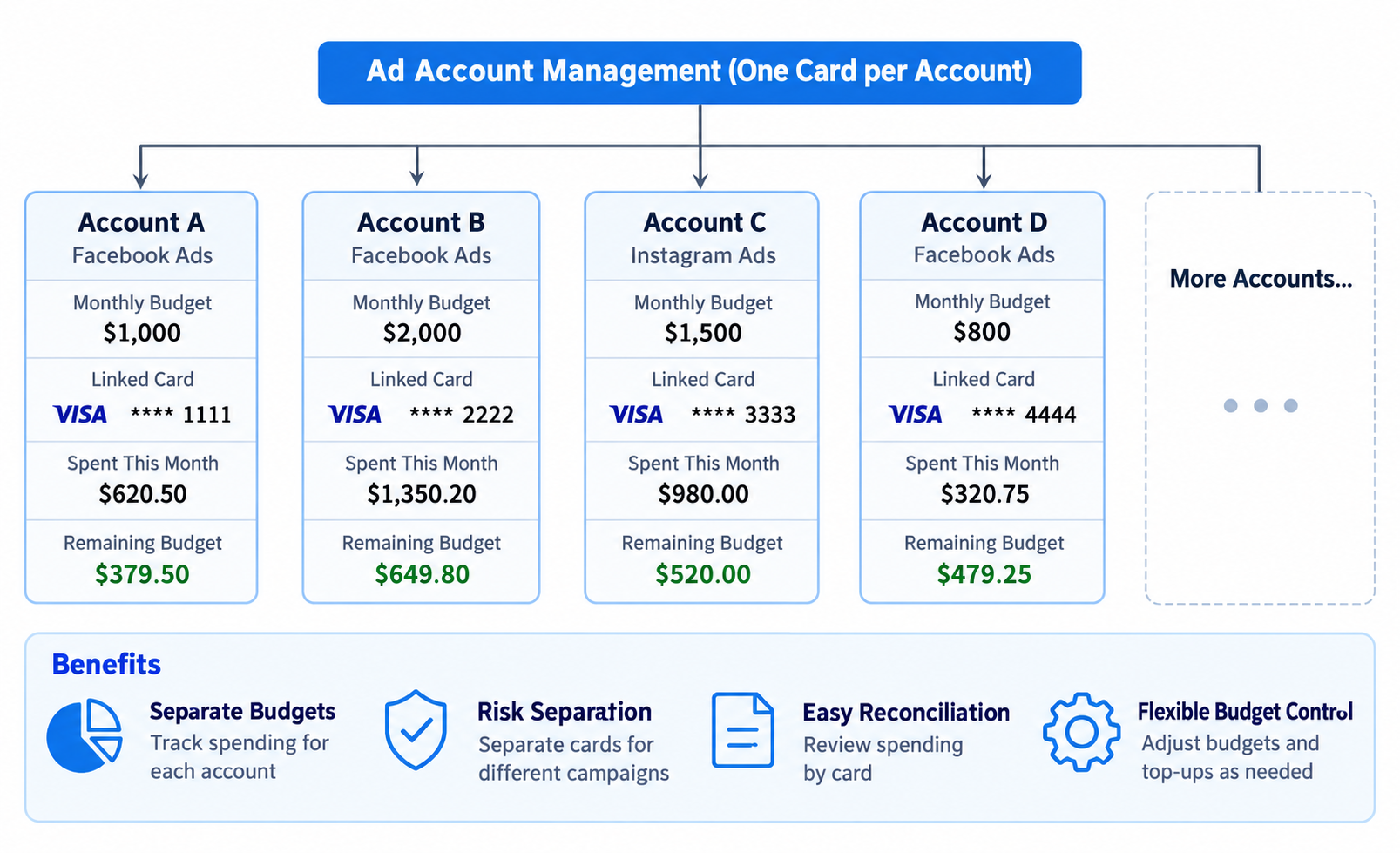
Many experienced advertising teams use the following practices:
✅ Assign a separate payment card to each advertising account;
✅ Check card balance regularly to avoid ad suspension due to insufficient balance;
✅ Avoid frequent changes to payment methods;
✅ Keep cardholder details and billing addresses consistent with issuer records;
✅ Use a Visa or Mastercard card that supports international advertising platform payments;
✅ Manage budgets separately by project, client, or advertising account to simplify reconciliation and limit the impact of payment problems.
FAQ (frequently asked questions)
Q1: If Facebook Ads payment fails, is it necessarily because the advertising account has been blocked?
Not necessarily. The problem may instead involve the card, its balance, risk checks, or payment details.
Q2: Can cards issued in China pay for Facebook Ads?
Some can, but payment outcomes depend on the issuing bank, card network, regional restrictions, and risk policies.
Q3: Why did payment work yesterday but fail today?
It may be that the bank's risk control has been upgraded, the balance has changed, the card status has changed, or Facebook has initiated a new risk review.
Q4: Will advertising stop immediately after payment failure?
If a charge becomes due and payment continues to fail, ads may be suspended until the payment succeeds.
Q5: Can one bank card be linked to several advertising accounts?
Technically it's usually possible, but from a budget management and risk isolation perspective, it's not recommended that multiple important advertising accounts share the same card for a long time.
Q6: Will changing the bank card affect the advertising account?
A routine change does not directly cause an account problem. Frequent changes within a short period may, however, increase the likelihood of a review.
Q7: What bank cards does Facebook Ads support?
Eligible international payment cards on networks such as Visa and Mastercard are typically supported. Acceptance remains subject to Meta's supported payment methods and the issuer's restrictions.
Q8: How to reduce the risk of payment failure?
Keep payment details accurate, maintain a sufficient balance, avoid frequent payment-method changes, and establish a consistent payment-management process.
Final thoughts
A failed Facebook Ads payment does not necessarily mean that the ad account has a problem. Common causes involve card status, cross-border payment restrictions, insufficient funds, risk checks, or incorrect payment details.
For teams running Facebook ads over the long term, consistent payment and budget management is as important as optimizing ad creatives and campaign strategies. Setting up suitable payment methods, checking account status regularly, and separating payment risks can help reduce interruptions caused by failed charges.
If you need to discuss Facebook Ads payments, account reliability, overseas advertising, or account risk checks, you can contact me below.
Telegram: @XK726
本文由 VCCMap 虚拟卡指南整理,转载请注明出处:https://vccmap.com/en/facebook-ads-%e6%94%af%e4%bb%98%e5%a4%b1%e8%b4%a5%e6%80%8e%e4%b9%88%e5%8a%9e%ef%bc%9f%e6%9c%80%e6%96%b0%e8%a7%a3%e5%86%b3%e6%96%b9%e6%a1%88%ef%bc%88%e9%99%84%e5%8e%9f%e5%9b%a0%e5%88%86%e6%9e%90-en/