How do virtual credit cards differ from physical bank cards? Which is safer, and what is each best suited for? This article compares card setup, payments, security, fees, and supported uses to help you choose a card that fits your needs.
What is the difference between a virtual credit card and a physical bank card?
As cross-border e-commerce, AI subscriptions, overseas shopping, and digital payments grow, more people are becoming familiar with virtual cards.
Many users will ask:
- Are virtual credit cards the same as bank cards?
- Can I pay without a physical card?
- Which one is safer?
- Should I get a physical or virtual card?
In fact, virtual credit cards and physical bank cards are both payment-card products. Their main differences are their format and intended use cases, rather than their basic payment function.
If you mainly spend money online, both can complete most online payments; if you need to withdraw cash from an ATM or swipe a card offline, a physical bank card usually has an advantage.
Below, we conduct a detailed comparison from multiple aspects.
What is a physical bank card?
Physical bank cards are the familiar cards many people use for everyday payments.
A physical card has:
- plastic card
- Chip (EMV)
- Magnetic stripe (some bank cards)
- card number
- Expiration date
- CVV security code
Physical bank cards can typically be used for:
- ATM cash withdrawal
- Payments at point-of-sale terminals
- Apple Pay
- Google Wallet
- online shopping
- Transfer and remittance
Many bank-issued cards on networks such as Visa, Mastercard, and UnionPay are available as physical cards.
What is a virtual credit card?
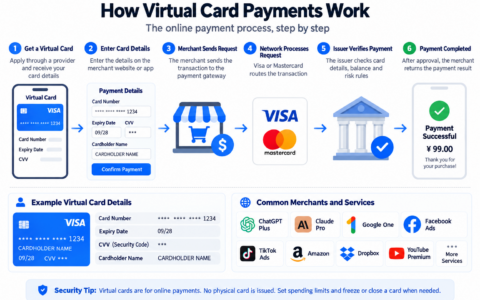
Virtual credit cards do not come with a physical plastic card.
Instead, you receive digital card details:
- Card Number
- Expiry Date
- CVV (security code)
- Cardholder Name
Although there is no physical card, the online payment process is almost the same as that of a physical bank card.
On many platforms, an approved application gives you access to the card details without waiting for a card to be printed and mailed.
Comparison between virtual credit card and physical bank card
| Feature | Virtual credit card | Physical bank card |
|---|---|---|
| Physical card | ❌ No | ✅ Yes |
| Online payments | ✅ Supported | ✅ Supported |
| In-person payments | Supported by some products, including through digital wallets | ✅ Supported |
| ATM cash withdrawals | Usually not supported | ✅ Supported |
| Time to obtain a card | Usually a few minutes to the same day | Days to weeks, depending on the bank |
| Card management | Online | Through a banking app or branch |
| Spending-limit management | Typically offers flexible settings, depending on the platform | Subject to bank rules |
| Freezing or cancelling a card | Generally available online | Usually available online or at a bank branch |
Neither format is inherently better in every situation. Each suits different payment needs.
What are the different usage scenarios?
When physical bank cards are more suitable
Everyday spending
For example:
- supermarket shopping
- Purchases at shopping malls
- Restaurant payments
- ATM cash withdrawal
Physical bank cards cover almost all traditional payment scenarios.
Travelling abroad
If you need to do the following, a physical card is often more convenient:
- Hotel check-in
- car rental
- ATM cash withdrawal
- offline shopping
Physical bank cards are often more convenient.
When virtual credit cards are more suitable
AI software subscriptions
For example:
- ChatGPT Plus
- Claude Pro
- Perplexity Pro
- Midjourney
Use different cards to manage different subscriptions, making it easier to check costs.
Corporate Procurement
For example:
- Microsoft 365
- Google Workspace
- cloud server
- domain name
- CDN
- SaaS software
Businesses can assign different cards by department or project to facilitate budget management and financial reconciliation.
Advertising
Advertising teams often link separate cards to different advertising accounts, for example on:
- Facebook Ads
- Google Ads
- TikTok Ads
- Reddit Ads
This allows for clearer management of ad spend across projects.
Overseas shopping
Many international e-commerce merchants accept online payments through Visa or Mastercard. Virtual credit cards are one option, but acceptance still depends on the merchant's rules and the card issuer's restrictions.
Which one is safer?
Many people think:
Is a card more vulnerable to theft if it has no physical form?
This is not the case.
Virtual credit cards are generally no more dangerous just because they don't have a physical card.
Virtual cards can offer management advantages for many online payments.
For example:
- Cards can be issued separately
- Each card can be frozen independently
- Each card can be cancelled independently
- Spending limits can be set, depending on the platform
- Segregated funds can be used for different purposes
If card details are leaked on one platform, you can deactivate the affected virtual card without necessarily affecting payments made with your other cards.
Whichever card you use, follow these precautions:
- Do not share your card number or CVV unnecessarily.
- Pay using the official website.
- Check transaction records regularly.
- Turn on SMS or app transaction notifications.
Which is faster to obtain?
In general:
Physical bank card
The process usually includes:
- Submitting an application
- Review by the bank
- Card production
- Postal delivery
The overall time may take several days to several weeks.
Many virtual card platforms instead offer:
- Online applications
- Online review
- Online card issuance
Once your application is approved, you can access the card details. This is usually faster than waiting for a physical card.
Can virtual credit cards replace physical bank cards?
The answer is:
Not completely.
Many situations still require a physical card, such as:
- ATM cash withdrawal
- Hotel deposit (some hotels)
- Some offline merchants
- Purchases that require presenting the card
On the other hand, virtual credit cards have advantages in:
- software subscription
- Corporate Procurement
- Cross-border payment
- Advertising
- Online budget management
Therefore, the two are more complementary than substitutes.
How to choose?
You can choose according to your own needs:
If you mainly use it for:
- daily consumption
- offline shopping
- ATM cash withdrawal
- traveling abroad
A physical bank card is usually the more suitable first choice.
If you mainly use it for:
- AI software subscription
- Overseas SaaS services
- Advertising
- Corporate Procurement
- Cross-border online payment
You can consider choosing a virtual credit card product that suits your business needs.
Frequently Asked Questions (FAQ)
Q1: Can a virtual credit card be added to Apple Pay or Google Wallet?
Some virtual credit cards can be added to digital wallets. Support depends on the card issuer, card network, and region.
Q2: Can a virtual credit card be used for in-person payments?
Some virtual cards can be used for in-person payments when they support digital wallets such as Apple Pay or Google Wallet and the merchant accepts contactless payments. Not all virtual cards have this capability.
Q3: Are physical bank cards definitely safer than virtual credit cards?
Not necessarily. Both use established payment-card security mechanisms. For online purchases, virtual credit cards can offer advantages because you can manage them independently, set limits, and deactivate them quickly.
Q4: Are virtual credit cards suitable for individuals or businesses?
They can serve both. Individuals often use them for overseas subscriptions and shopping, while businesses use them for purchasing, advertising, and expense management.
Summary
Virtual credit cards and physical bank cards are not in competition, but two solutions for different payment needs.
If most of your spending is in person, a physical bank card is usually the first choice. If you often make cross-border payments, subscribe to overseas services, or manage business purchases and online expenses, virtual credit cards can offer more flexible payment management.
Many individuals and businesses use both physical bank cards and virtual credit cards, choosing between them according to the purchase. This combination reflects the development of digital payments.
本文由 VCCMap 虚拟卡指南整理,转载请注明出处:https://vccmap.com/en/%e8%99%9a%e6%8b%9f%e4%bf%a1%e7%94%a8%e5%8d%a1%e5%92%8c%e5%ae%9e%e4%bd%93%e9%93%b6%e8%a1%8c%e5%8d%a1%e6%9c%89%e4%bb%80%e4%b9%88%e5%8c%ba%e5%88%ab%ef%bc%9f%e4%b8%80%e7%af%87%e7%9c%8b%e6%87%82%ef%bc%88-e/